
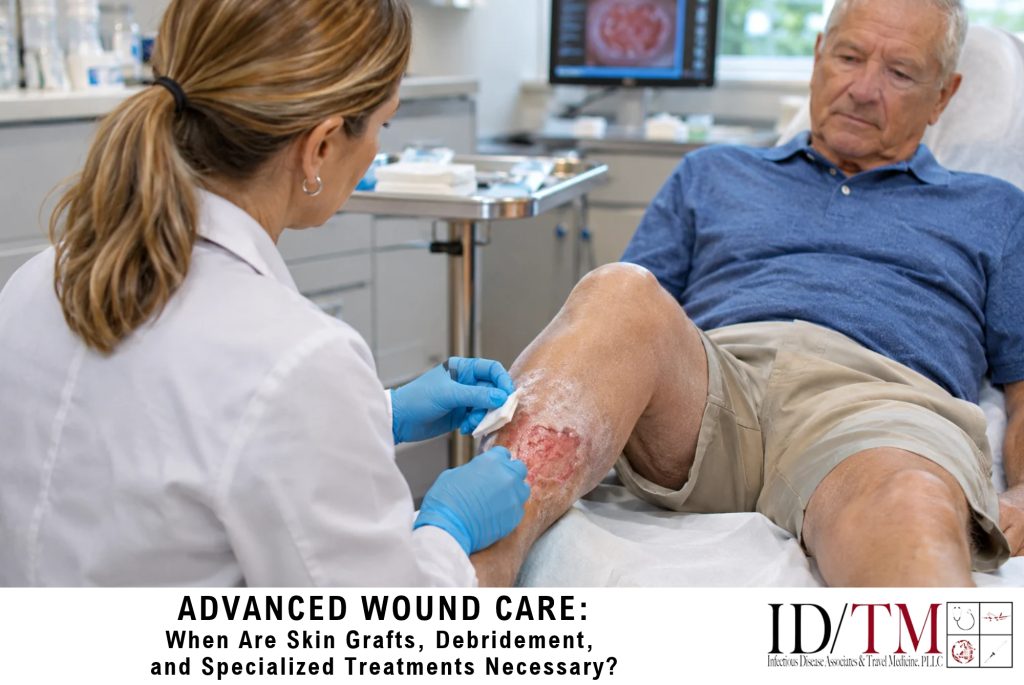
Most minor wounds heal through the body’s natural tissue repair processes. However, some wounds remain open for weeks or months because of diabetes, poor circulation, infection, pressure, or other underlying medical conditions.
When conventional wound care does not produce adequate improvement, advanced treatment may become necessary. Depending on the wound, physicians may recommend debridement, specialized dressings, skin grafting, pressure offloading, vascular intervention, or other evidence-based treatments.
Advanced wound care is not simply about covering an open wound. It involves identifying and correcting the factors preventing tissue repair.
At Infectious Disease Associates and Travel Medicine, patients in Gainesville, Lake City, and surrounding North Central Florida communities can receive evaluation for nonhealing wounds and wound infections, with treatment recommendations tailored to their individual medical needs.
What Is Advanced Wound Care?
Advanced wound care refers to specialized evaluation and treatment for wounds that are complex, slow to heal, or associated with significant underlying medical conditions.
These wounds may involve damaged skin, deeper tissue structures, impaired circulation, or persistent infection.
When Does a Wound Become Chronic?
A chronic wound fails to progress through the expected stages of healing.
There is no single time threshold that applies to every wound. However, a wound that shows little improvement over several weeks, repeatedly reopens, or deteriorates despite appropriate care warrants further investigation.
Patients with diabetes, vascular disease, or immune system impairment should seek evaluation earlier because complications can develop before a wound becomes longstanding.
What Types of Wounds May Require Advanced Treatment?
Diabetic Foot Ulcers
Diabetic foot ulcers frequently develop because of neuropathy, repetitive pressure, and impaired circulation.
Successful treatment requires more than topical wound care. Pressure reduction, circulation assessment, and diabetes management are essential.
Venous Leg Ulcers
Venous ulcers result from impaired venous circulation, which can cause chronic swelling and skin breakdown.
They often develop around the lower leg or ankle.
Compression therapy is a central treatment when arterial circulation is adequate.
Arterial Ulcers
Arterial ulcers occur when inadequate blood supply prevents tissue from receiving sufficient oxygen and nutrients.
These wounds may require vascular intervention before healing can occur.
Pressure Injuries
Pressure injuries develop when prolonged pressure damages the skin and underlying tissue.
They are particularly concerning in patients with limited mobility.
Treatment includes pressure redistribution, appropriate dressings, nutritional assessment, and management of complications.
Postsurgical Wounds
Some surgical incisions fail to close properly because of infection, inadequate circulation, tissue tension, or other medical factors.
Persistent drainage, wound separation, or increasing inflammation requires medical assessment.
Why Is Debridement Important in Advanced Wound Care?
Debridement is the removal of dead, damaged, or infected tissue from a wound.
Nonviable tissue can interfere with healing, obscure the wound’s true depth, and contribute to infection.
Surgical or Sharp Debridement
Sharp debridement uses appropriate instruments to remove nonviable tissue.
It can be particularly useful when a wound contains substantial dead tissue or requires rapid removal of infected material.
Enzymatic Debridement
Enzymatic products help break down certain types of nonviable tissue.
This approach may be appropriate when selective tissue removal is preferred.
Autolytic Debridement
Autolytic debridement uses the body’s natural processes, supported by appropriate moisture-retaining dressings, to break down dead tissue.
It is generally slower than sharp debridement.
When Should Debridement Be Avoided or Delayed?
Not every wound should undergo immediate debridement.
For example, stable dry eschar on a severely ischemic foot requires careful assessment because removing protective tissue before addressing circulation can worsen the wound.
The choice of debridement method depends on infection, circulation, tissue viability, and the patient’s overall condition.
When Are Skin Grafts Necessary?
Skin grafting is a procedure that transfers skin or uses selected tissue-based materials to help cover a wound.
It is considered when a wound cannot close adequately through conventional healing alone.
Traditional Skin Grafts
An autologous skin graft uses skin obtained from another location on the patient’s body.
The graft is placed over an appropriately prepared wound bed.
Successful grafting requires sufficient circulation, infection control, and protection from excessive pressure or movement.
Cellular and Tissue-Based Products
Certain advanced wound products contain biological or engineered materials designed to support tissue repair.
These products may be considered for selected chronic wounds that have not responded adequately to evidence-based standard care.
Are Skin Grafts Appropriate for Every Chronic Wound?
No. Skin grafting is not a substitute for adequate blood circulation, infection treatment, pressure reduction, or management of underlying disease.
A graft placed on a poorly perfused or actively infected wound may fail.
Treatment selection should be based on wound characteristics and available clinical evidence.
The International Working Group on the Diabetic Foot’s wound-healing guideline provides recommendations for evaluating adjunctive treatments for diabetes-related foot ulcers.
IWGDF Guidelines
What Other Specialized Treatments Can Support Wound Healing?
Advanced Wound Dressings
Modern wound dressings help maintain an appropriate moisture balance, absorb excess drainage, and protect surrounding tissue.
The ideal dressing depends on wound depth, drainage, infection status, and skin condition.
Negative-Pressure Wound Therapy
Negative-pressure wound therapy uses controlled suction to manage wound fluid and support healing in selected wounds.
It can be useful for certain postoperative or complex wounds.
However, it should not be used solely as an adjunctive treatment to cure a diabetic foot infection.
Pressure Offloading
Pressure offloading reduces mechanical stress on a wound.
For plantar diabetic foot ulcers, appropriate offloading is often one of the most important elements of treatment.
Compression Therapy
Compression can help manage venous hypertension and swelling in patients with venous leg ulcers.
Before significant compression is prescribed, clinicians must assess whether arterial circulation is sufficient.
Vascular Intervention
When poor blood flow prevents healing, patients may require vascular evaluation and procedures to restore circulation.
Nutritional and Metabolic Support
Adequate protein, energy intake, and correction of nutritional deficiencies support tissue repair.
Diabetes management and treatment of other chronic illnesses are also important.
Hyperbaric Oxygen Therapy
Hyperbaric oxygen therapy may be considered for selected wounds under specific clinical circumstances.
It is not routinely recommended solely to treat diabetic foot infection, and its use should follow an individualized assessment of wound-healing indications and evidence.
How Do Physicians Decide Which Wound Treatment Is Appropriate?
The treatment plan begins with a comprehensive wound assessment.
Wound Size and Depth
The clinician measures the wound and evaluates whether deeper tissues are involved.
Circulation
Adequate blood supply is essential for tissue healing and successful grafting.
Infection Status
Clinicians distinguish bacterial colonization from clinical infection.
Antibiotics are reserved for wounds with infections requiring antimicrobial treatment.
Previous Treatment Response
The physician reviews which interventions have already been attempted and whether the wound has improved.
Underlying Medical Conditions
Diabetes, vascular disease, immune system disorders, mobility limitations, and nutritional status influence treatment decisions.
Can Advanced Wound Care Prevent Amputation?
Advanced wound care can contribute to limb preservation when it is combined with appropriate treatment of the underlying causes.
For diabetic foot ulcers, successful management may require pressure offloading, infection control, vascular assessment, debridement, and coordinated specialty care.
However, no individual treatment guarantees prevention of amputation.
The greatest benefit comes from recognizing problems early and developing a comprehensive treatment plan.
When Should You See an Infectious Disease Specialist for a Chronic Wound?
An infectious disease specialist can help when a wound develops persistent infection, repeatedly becomes infected, involves resistant bacteria, or raises concern for osteomyelitis.
Specialized evaluation can determine whether antimicrobial treatment is necessary and which medications are appropriate.
Infectious Disease Associates and Travel Medicine lists wound care among its services, alongside treatment for diabetic foot infections, osteomyelitis, and IV infusions. Specific advanced procedures should be confirmed during consultation.
idtmhealth.com
Frequently Asked Questions About Advanced Wound Care
When does a wound need advanced treatment?
Advanced treatment should be considered when a wound fails to improve with appropriate care, repeatedly reopens, involves deeper tissue, or is complicated by poor circulation or infection.
Is wound debridement painful?
Discomfort varies according to the method, wound location, and nerve function. Clinicians can use appropriate pain-control strategies when necessary.
How long does it take for a skin graft to heal?
Initial graft attachment and healing often occur over the first several weeks, but complete recovery depends on the wound, circulation, graft type, and overall health.
Can skin grafts fail?
Yes. Infection, inadequate blood flow, excessive pressure, fluid accumulation, or movement can interfere with graft survival.
Do all chronic wounds require antibiotics?
No. Antibiotics are indicated when a bacterial infection is present and requires treatment. Uninfected chronic wounds do not benefit from antibiotics solely to promote closure.
Is negative-pressure wound therapy appropriate for every wound?
No. It is used for selected wound types and is not suitable for every patient. Treatment requires appropriate wound assessment and monitoring.
Can poor circulation prevent advanced wound treatments from working?
Yes. Inadequate blood flow can prevent tissue repair and compromise skin graft survival. Vascular treatment may be necessary before wound closure.
Are advanced wound dressings better than ordinary bandages?
Specialized dressings can provide advantages for particular wound characteristics, but no single dressing is best for every wound.
Can chronic wounds become infected even with professional care?
Yes. Chronic wounds remain vulnerable to infection, particularly when underlying risk factors persist. Regular monitoring helps identify complications early.
Expert Medical Resources
For additional evidence-based information, review the IWGDF wound-healing interventions guideline, the IWGDF/IDSA diabetic foot infection guidelines, and the National Institute of Diabetes and Digestive and Kidney Diseases.
Contact Information
Infectious Disease Associates and Travel Medicine
Gainesville Office
3600 Northwest 43rd St., Suite D-2
Gainesville, FL 32606
Phone: (352) 225-3650
Lake City Office
733 SW State Rd. 47
Lake City, FL 32025
Phone: (352) 225-2650
Website: idtmhealth.com
If you have a nonhealing wound, persistent wound infection, or concerns about advanced wound treatment, contact Infectious Disease Associates and Travel Medicine to discuss an individualized evaluation.